
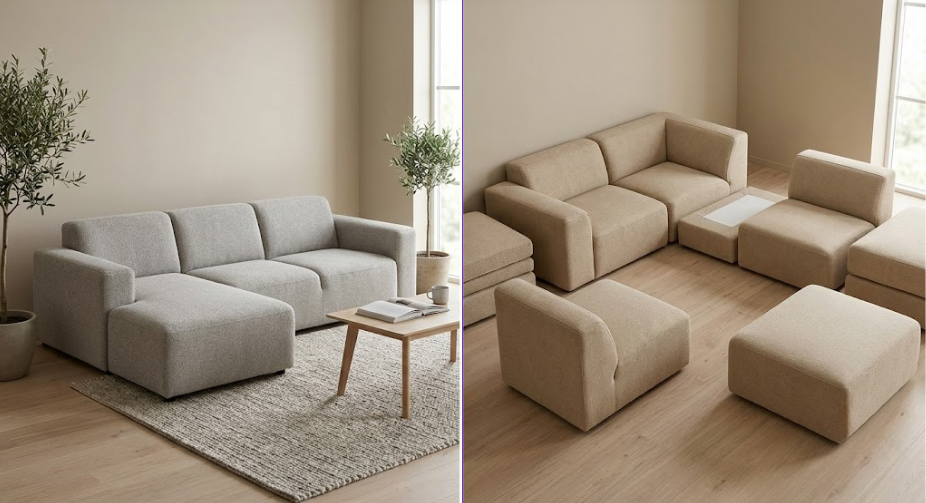
L-Shaped vs U-Shaped Sofa: Seats, Space and the Wall You Give Up
You’ve measured the living room twice. You’ve got a rough idea of your budget. And you’re still stuck on one question: L-shaped or U-shaped?
This is where most buyers make their decision. When you’re trying to find the best sofa shape for small living room layouts, consider your available floor space and walking clearance first.
It’s a more consequential decision than it looks. These two sofa shapes don’t just differ in size; they change how a room functions, how many people can comfortably gather, and how much of your wall space disappears for good. Here’s what actually separates them, seat by seat and wall by wall.
How Many People Each Shape Actually Seats
An L-shaped sofa typically seats four to six people comfortably, depending on the length of each arm. It uses one long run and one shorter chaise section, which makes it efficient without demanding too much of the room.
A U-shaped sofa goes further. With three sides instead of two, its U-shaped sofa seating capacity allows six to eight people to sit comfortably, sometimes more with modular add-ons. The extra side also changes the seating dynamic. People face each other rather than lining up shoulder to shoulder, which naturally encourages conversation. For a household that regularly hosts family gatherings, that layout can matter more than the raw seat count.
The trade-off is that this extra capacity pulls seating further into the centre of the room, which brings us to space.
How Much Room Each Layout Really Needs
This is where most buyers make their final decision.
An L-shaped sofa works well for most UAE apartments and mid-sized villa living rooms. Its footprint tucks neatly into a corner, leaving the rest of the room open for a console, a media unit, or simply room to move. As a general guide, most L-shaped sofas need around 3 to 3.5 metres along the longer side and roughly 2 metres along the chaise.
A U-shaped sofa needs meaningfully more open floor area. A room width of at least 4 metres helps prevent the space from feeling boxed in. Its U-shaped sofa seating capacity suits larger households, but the additional seating also pushes the sofa further from the walls. The third side needs its own clearance to keep the walking paths open. This layout works beautifully in larger villa majlises or open-plan living areas, but it can overwhelm a compact apartment with awkward gaps around the walking paths.
The Wall You Give Up (and Why It Matters More Than You Think)
Here’s the part buyers often miss until the sofa arrives.
An L-shaped sofa occupies two walls, or one wall plus a floating corner position, while leaving the rest of your walls free for shelving, artwork, a TV console, or simply breathing room. This shape shares the room rather than dominating it.
A U-shaped sofa, by contrast, typically claims an entire wall as its anchor and extends outward on both sides. Practically speaking, that wall is gone: you lose space for a console table beneath the TV, a sideboard, or a gallery wall. In exchange, you get a self-contained seating zone. For some living rooms, that trade is worth it. For others, especially where the TV or storage wall is non-negotiable, you should think through the layout before ordering.
Which Shape Fits Your Living Room
The right choice depends on your room dimensions, layout and daily needs. If you’re searching for the best sofa shape for small living room spaces, consider how much floor area you need to keep open for movement, storage and other furniture before choosing between an L-shaped and U-shaped design.
A few honest questions can settle this faster than any spec sheet:
If you’re specifically looking for the best sofa shape for small living room spaces, an L-shaped sofa usually makes the more practical choice because it uses corners efficiently without taking over the entire floor.
- Is your living room under 20 square metres? An L-shaped sofa will almost always feel more proportionate.
- Do you regularly host six or more guests at once? A U-shaped layout earns its footprint here.
- Do you need a full wall free for a TV unit or storage? Go L-shaped.
- Is the room open-plan with generous clearance on all sides? A U-shaped sofa can become the room’s natural centrepiece.
There’s no universally “better” shape, only the one that matches how you actually use the room day to day, not just how it looks in a showroom photo.
FAQs
Is an L-shaped or U-shaped sofa better for a small living room? An L-shaped sofa generally works better for smaller or apartment-sized living rooms in the UAE because it uses a corner efficiently and leaves the rest of the room open.
How much space does a U-shaped sofa actually need? Most U-shaped sofas need a room width of at least 4 metres to allow comfortable walking space around all three sides without making the layout feel cramped.
What is the U-shaped sofa seating capacity? L-shaped sofas typically seat four to six people, while U-shaped sofas can comfortably fit six to eight people. This makes the U-shape better suited to larger households or frequent entertaining.
Does a U-shaped sofa work in an apartment? It can, but only in larger open-plan apartments. In more compact layouts, the extra side tends to crowd walkways and reduce usable floor space.
Which shape is easier to rearrange later? L-shaped sofas are generally easier to reposition, and many come with a reversible chaise, giving you more flexibility if you move homes or redesign the room later.