
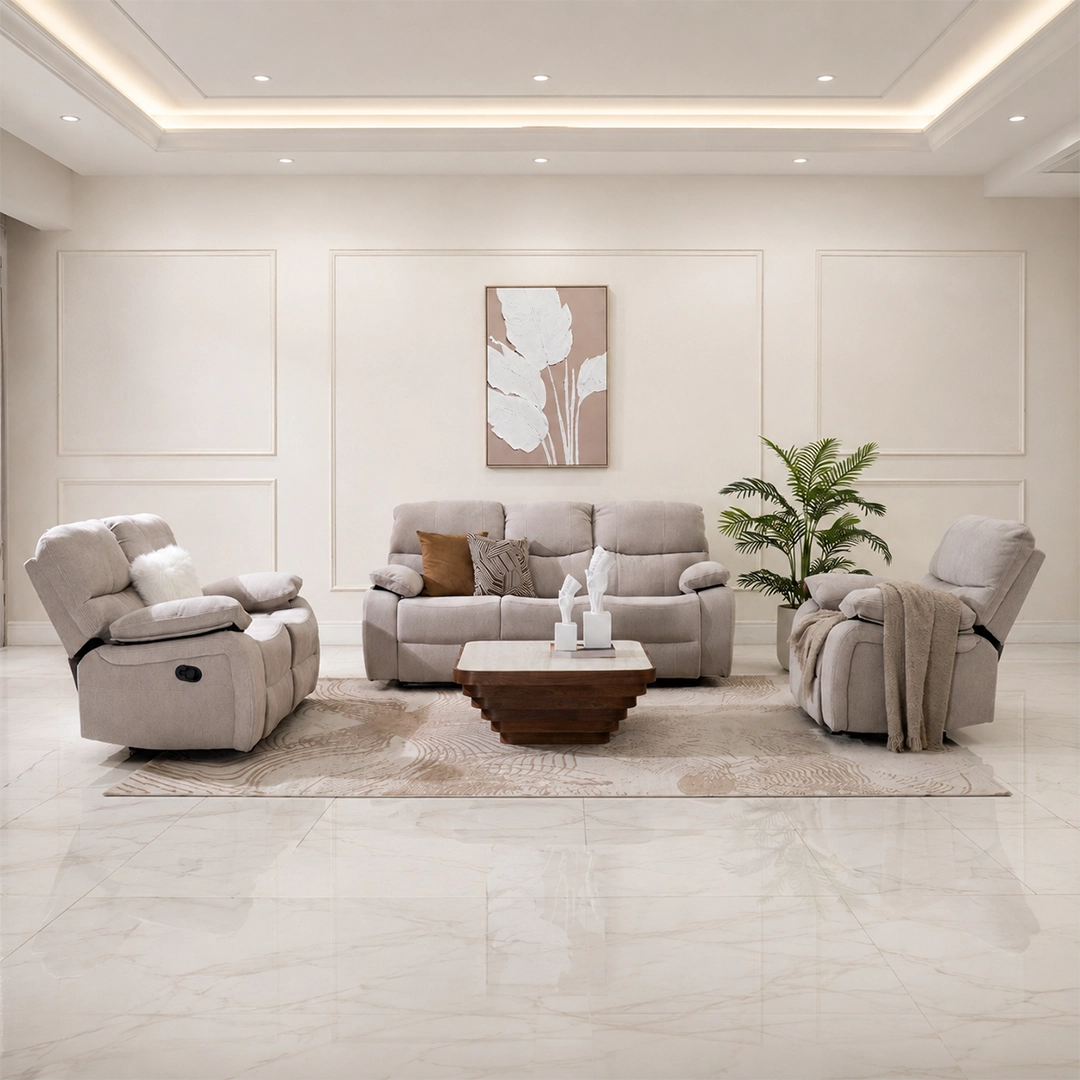
Manual vs Electric Recliner: How the Mechanisms Differ
Picture the end of a long day. You sink into the corner of the sofa, reach for the lever, and the footrest rises smoothly. Or you press a button and the backrest eases back without any effort. Both are recliners, but understanding the difference between a manual vs electric recliner helps you choose the right mechanism for your everyday comfort.
Understanding how does an electric recliner work can help you decide whether a motorised mechanism is the right choice for your home. Understanding the different recliner mechanism types can help you choose a sofa that matches your comfort needs and lifestyle.
How a Manual Recliner Works
If you are wondering how does an electric recliner work, it uses a small built-in motor controlled by a button or switch to adjust the footrest and backrest. You move the footrest up with the lever and press back with your body weight to tilt the backrest. There is no motor, so there is nothing to plug in and very little that can go wrong electrically.
Manual mechanisms suit people who like a simple, direct feel and want to place the sofa anywhere in the room without thinking about sockets. The trade-off is that they ask for a little effort, and the recline positions are usually limited to closed, partly open and fully open. Among the common recliner mechanism types, manual designs are known for their simple operation and straightforward mechanical construction.
How an Electric Recliner Works
An electric recliner replaces the lever with a small motor driven by a button or switch. Press and hold, and the footrest and backrest move together or separately, depending on the model. Because the motor controls the movement, you can stop at almost any angle rather than choosing from fixed positions.
Power comes from a cable to a wall socket, and some models add a rechargeable battery option or a USB port on the arm. That convenience is the reason many households prefer electric mechanisms, especially for people who find a lever awkward.
Which One Suits Your Home
- Choose manual if you want fewer parts to maintain, you move furniture around often, or the sofa will sit far from a socket.
- Choose electric if you value smooth, effortless adjustment, want precise angles, or are buying for someone who finds levers tiring.
- Either way, check how far the seat travels back. A wall-hugger design needs only a short gap, while a standard recliner can need noticeably more room behind it.
When comparing recliner mechanism types, consider ease of use, available space, maintenance and the power requirements of each design. Choosing between a manual vs electric recliner ultimately depends on your comfort preferences, available space and how often you plan to adjust the seating position.
Think about who uses the sofa most. A household with older relatives, or anyone who finds lever action tiring, benefits from the smoother control of a motor. A busy family room, where the sofa is shared and sometimes treated roughly, may suit the simplicity of a manual mechanism, since there are fewer parts to be disturbed by spilled drinks or curious hands.
If you are also deciding how many seats you need, our guide to matching seat count to room width helps, and our post on the benefits of a recliner sofa at home covers comfort in more detail.
What to Avoid
Most disappointment with recliners comes from planning, not the mechanism itself. Buyers forget to measure the space behind the sofa, which stops the backrest from reclining fully. Others choose an electric model without checking where the nearest socket is, then run a cable across the floor. A third mistake is ignoring the doorway: a recliner with its mechanism attached can be wider and heavier than a plain sofa, so measure the entrance, lift and stairwell before ordering.
Also test the footrest with your own height in mind. A footrest that is too short or too high is more irritating than any mechanism. Finally, consider the upholstery: recliner arms and headrests are handled far more than the rest of a sofa, so a fabric or leather that wipes clean easily is worth some extra thought.
Frequently Asked Questions
How does an electric recliner work?
An electric recliner works using a motorised mechanism that moves the footrest and backrest when you press a control button. Depending on the model, you can adjust both sections together or independently.
Do electric recliners need to stay plugged in?
Most need power to move, though some include a battery pack for flexibility. Check the model details for exactly how it is powered.
Is a manual recliner harder to use?
It takes a little more effort than a button, but most people find it easy after the first few uses. If strength or mobility is a concern, an electric model is usually kinder.
Can a recliner fit in a small living room?
Yes. Look at wall-hugger designs and compact two-seaters that need only a short gap behind them, and measure the room before you choose.
Find Your Recliner
At The Home, our Recliner Sofas collection brings together recliner designs for the living room, and you can browse online across the UAE or try them in our Dubai showroom. Ask the team which mechanism each model uses. Pair a recliner with a matching sofa set or a compact 2-seater sofa to complete the room.