
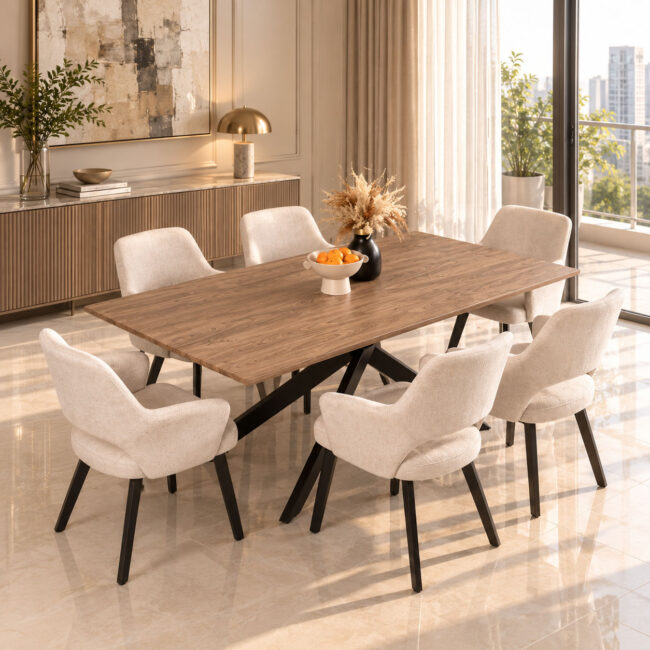
Pedestal Base or Four Legs: Which Dining Table Gives More Legroom?
A pedestal dining table stands on a central column or a pair of solid supports, instead of a leg at every corner. A four-leg table uses the traditional arrangement with one leg in each corner. The choice looks like pure style, yet it changes how many people sit comfortably, how easy it is to squeeze in an extra chair and how steady the table feels when someone leans on it.
Legroom and Seating
Legroom is the strongest argument for a pedestal. With no legs at the corners, you can place chairs at any point around the table and nobody has to straddle a leg. That helps at a round table, where seats are shared evenly around the edge, and it helps when guests arrive and you need to add a chair.
A four-leg table gives each seat a defined position. The corners are the awkward spots, since a leg can sit exactly where someone’s knee wants to go. Longer tables often have more usable seating along the sides, and the legs set the layout clearly, which some people prefer.
As a guide, keep around 25 to 30 cm between the seat and the tabletop underside, whichever base you choose, and allow roughly 60 cm of table edge per person. Our guides to 4-seater vs 6-seater and 6-seater vs 8-seater tables help you size the top.
Stability and Shape
Four legs spread the load and resist tipping, which suits large tables, heavy tops and homes with energetic children. A pedestal concentrates support in the centre. A well-made, wide base is very steady, but a narrow column under a large top can feel less secure if someone leans on the edge.
Shape matters here too. Round and square tops suit a single central pedestal, because the load is balanced around one point. Long rectangular or oval tables usually need two pedestals or a wide base to stay stable along their length, so check how the base is built rather than assuming it will be sturdy.
A Few Things Worth Knowing
Chairs and the base. Pedestal bases can be wide at the floor, so chairs pushed in fully may hit the base. Test with the chairs you plan to use.
Material and weight. Solid stone or thick glass tops are heavy, so the base must be rated for them. Our look at solid wood, MDF and veneer explains how top materials age.
Cleaning. A single base is easier to vacuum around than four legs, which helps in a family kitchen.
Room fit. In a small dining room, a round pedestal table lets you slide past more easily, because there are no corners and no outer legs to bump. In a long, narrow room, a rectangular table on four legs usually uses the space more predictably.
Extending tables. If you want a table that grows for guests, ask how the extension is supported. Some designs rely on the legs or a wider base to hold the extra leaf, so the base style you choose can limit how far the table opens.
Look and feel. A pedestal base gives a sculptural, softer look and suits round tops in particular. Four legs read as classic and lighter, and they let you see more of the floor beneath the table.
Seat count. If you often host, check the dimensions as well as the style. Our guide to 8-seater dining table dimensions shows how much room a larger table needs.
Frequently Asked Questions
Are pedestal tables stable?
They can be very stable when the base is wide and well built. The key is to match the size of the base to the size of the top, so ask how the table is constructed.
Which base is better for a small dining room?
A round pedestal table often feels more open because there are no corners and no corner legs. Measure your room before you decide, as the table still needs space to pull out chairs.
Can a rectangular table have a pedestal base?
Yes. Long tables usually use two pedestals or a wide base, which keeps the legroom while holding up the length.
See the Difference in Person
At The Home, you can compare table bases among our Dining Sets, online across the UAE or at our Dubai showroom, where you can sit at a table and check the legroom for yourself. Browse the wider Dining Room collection to complete the space with chairs and storage.